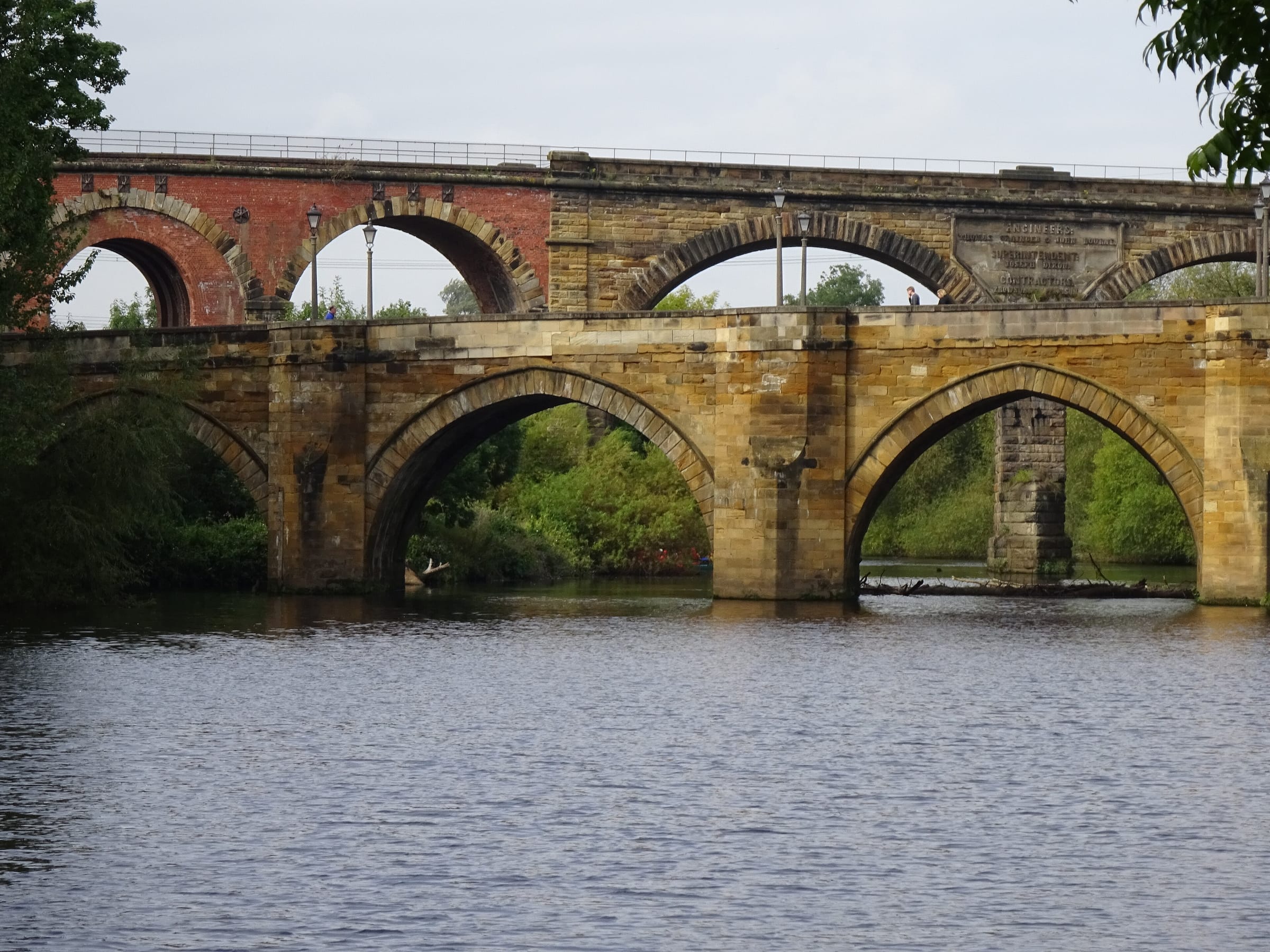
A Georgian High Street on the River Tees
Yarm is a market town on the River Tees in the north-east of England, known for its broad High Street, Georgian architecture, independent shops and restaurants, and its position as a gateway to Teesdale, the North York Moors and the coast. The Tees curves around the town on three sides, and the ancient stone bridge, built in the medieval period, still carries traffic across the river. The Town Hall, an early eighteenth-century building, stands in the centre of the High Street, and the long, cobbled street still feels like a market place.
Yarm's heritage as a trading town runs deep. A market was established here in the early thirteenth century, and the great Yarm Fair, once a major event for horse and cattle dealers, drew visitors from far afield. The Yarm Viaduct, a mid-nineteenth-century railway structure of many arches, strides across the valley and offers a handsome backdrop to riverside walks. Visitors who like characterful small towns also enjoy Scotland and Ireland, and Yarm makes an elegant English complement.
Boutiques, Brasseries and Riverside Walks
Today, Yarm is known for the quality of its eating and shopping. Independent boutiques, delicatessens and gift shops line the High Street, and the town has gained a reputation for its restaurants, bistros and traditional inns, many set in converted Georgian buildings. Weekend visitors enjoy long lunches, afternoon tea and a stroll along the Tees. The riverside paths offer gentle walking and cycling, with views of the bridge, the viaduct and the water meadows along the river.
The surrounding area adds depth. Preston Park Museum, in nearby Stockton, offers Victorian street scenes and parkland, and the Captain Cook Birthplace Museum in Marton tells the story of the great navigator. Durham, with its UNESCO-listed cathedral and castle, lies within easy reach, and the coast at Saltburn and Whitby is a short drive away. A tourist board can use Yarm as a base for a heritage and food trail across the Tees Valley and beyond.
Getting There and Making a Base
Yarm has its own railway station and sits close to the A19 and A66, which makes it simple to reach from across the North East and Yorkshire, and Durham Tees Valley Airport is close by. Newcastle and Leeds Bradford airports and the East Coast Main Line add further options for visitors from London and elsewhere in the UK. Spring and summer bring open-air events and long evenings, while autumn colours the riverbanks and winter adds festive lights and cosy dining.
For hotels and short-break operators, Yarm's combination of style and location is a strong selling point. A name like Yarm.co.uk gives airlines and boards one clear page to feature the town alongside the wider region, and guests can easily extend to the Channel Islands or other European getaways. The North York Moors National Park and the Yorkshire coast reward guests who stay a few nights rather than a single day.
Coaching Inns, Village Retreats and Seaside Escapes
Yarm itself offers a small choice of characterful places to stay, chiefly traditional inns and boutique rooms on or near the High Street, ideal for weekend visitors who want restaurants and riverside walks on the doorstep. Guests who prefer a quieter setting find village stays in Hurworth, Middleton One Row and Eaglescliffe, where country pubs with rooms and bed and breakfast houses sit among green lanes. Families often choose a base near Preston Park, with its museum, lawns and play areas close at hand.
The wider region adds options for every mood. Teesdale's stone villages and market town of Barnard Castle have farmhouse stays and cosy inns for walkers, while Durham's old streets hold historic hotels beside the cathedral for culture seekers. On the coast, Saltburn-by-the-Sea has Victorian seafront guesthouses near its pier and surf beach, and Whitby's cliff-top terraces overlook the abbey and harbour. Golf lovers and larger groups can find country hotels with courses and spa facilities within a short drive of the town.
Parmo Nights, Kippers and Riverside Festivals
The food of Teesside has its own personality. The parmo, a crisp breaded chicken or pork cutlet topped with cheese sauce, is a local institution, while Yarm's restaurants lean towards modern British and Mediterranean menus. Further along the coast, Whitby is known for fish and chips and oak-smoked kippers, and the North York Moors provide lamb, game and farmhouse cheeses such as Wensleydale. Afternoon tea with scones and a pot of Yorkshire tea is the traditional treat, and the town's delicatessens make easy picnic stops for riverside walks.
Culture here is rooted in industry and invention. The Stockton and Darlington Railway, the world's first public steam passenger line, opened in 1825, and railway heritage is celebrated at Darlington's Head of Steam museum. Middlesbrough has the Transporter Bridge and the MIMA gallery, while the Stockton International Riverside Festival brings street theatre and music every summer. Durham's Lumiere light festival lights up the cathedral city in winter, and Yarm's own seasonal Christmas lights and spring market days keep the High Street lively throughout the year.
Waterfalls, Moors Railways and Whitby Days Out
Yarm is a gateway to some of England's best landscapes. In Upper Teesdale, High Force is one of the country's largest waterfalls, reached by a woodland path, and the Pennine Way offers bigger walking days. Roseberry Topping, a distinctive hill known as the Cleveland Matterhorn, rewards a short climb with wide views, and the Cleveland Way follows the coast and moors for long-distance hikers. Cyclists follow the Tees Valley routes, and the Tees Barrage offers white-water paddling for those who like a splash.
Day trips are plentiful. The North York Moors Railway runs steam services between Pickering and Whitby, where the ruined abbey and the Dracula associations draw visitors to the cliff top. Barnard Castle has the Bowes Museum, a French-style chateau full of art, and the Captain Cook Birthplace Museum is close by. An AI platform can suggest personalised itineraries for these routes, and guests wanting a longer holiday can add Scotland or Ireland, or fly onwards to Brussels and Dubai. A short flight also opens Europe's wider city breaks.
Planning your stay
Yarm is a market town on the River Tees, in the Stockton-on-Tees borough, with a population of about 9,600 at the 2021 census. Stockton-on-Tees is five miles to the north east, and Darlington is eleven miles to the west. Its post town is Yarm, in the TS15 postcode district.
The town is best known for its high street, which was voted Britain's best in a 2007 BBC Breakfast poll, and for the Yarm Viaduct, which spans the town. It is a small place with a clear identity, and a very different scale from Scotland or the other places in this group.
History and landmarks
Yarm was first mentioned in the Domesday Book of 1086. Bishop Skirlaw of Durham built a stone bridge across the Tees in 1400, and the bridge still stands. The railway viaduct, built between 1849 and 1851, is 2,280 feet long and has 43 arches.
The Yarm helmet, a Viking Age helmet from around the 10th century that was found in the town, is displayed nearby at Preston Park Museum. Dominican friars settled in Yarm around 1286, and their memory survives in the names of the Friarage and Spital Bank. The Rookery, a woodland by the Tees owned by Yarm Town Council, offers a riverside walk.
Yarm Fair and local events
A funfair is held on the High Street in the third week of October, and the tradition evolved from a historic cheese and livestock trading fair. It is the town's best known annual event, and it affects traffic, parking and trading on the high street, so plan around it if you are visiting for a day.
Yarm School's Princess Alexandra Auditorium, a 750-seat venue opened in 2012, and the smaller Friarage Theatre host performances, so check what is on before you go.
Yarm School, now centred on the Friarage, built in 1770 on top of the cellars of the Dominican friary for the Meynell family, is one of the town's best known institutions. The Friarage and the old bridge show how much of the town's history is still visible on a short walk from the High Street to the river.
The town has three primary schools, which is typical of a settled market town rather than a resort. Visitors usually come for the high street, the river and the events, so a half day is enough for most itineraries, and it combines well with a visit to Preston Park Museum.
Getting there
Yarm railway station, opened in 1996, is on Green Lane about a mile south of the High Street, and Eaglescliffe station also serves the area. Teesside International Airport, which Wikipedia places at Middleton St George in the Borough of Darlington, offers domestic and international flights, and VisitGuernsey lists Teesside among the UK airports with flights to Guernsey, so the town has a direct link to the Channel Islands.
The High Street is the A67, and a ban on heavy goods vehicles through Yarm and Eaglescliffe was introduced in 2012. Allow extra time for traffic, particularly during the funfair and busy weekends.
Local government and sources
Yarm is a civil parish, and Wikipedia says Yarm Town Council owns the Rookery, a woodland by the Tees that is about 200 years old. The council is the best place to confirm local facilities and notices.
We have kept this guide modest because the town is small, and we have not included claims we could not check against a published source. For anything time sensitive, check with the council, the venues and the operators directly.
Before you travel
Entry requirements and official travel guidance are updated regularly, so check the latest position with your government before booking. The sources we used are listed at the foot of this page.
Why Yarm matters to the industry
Yarm shows that a small, well known town name can anchor a local visitor guide, with clear links to a regional airport and rail. Yarm.co.uk lets a tourist board or hotel group publish accurate local information, and an airline or online travel agency can use it to explain access.
See our destination guides and the AI platform page, or compare with Ireland and the wider Europe guide.
Questions travellers ask about Yarm
Where is Yarm?
Yarm is a market town on the River Tees, five miles south west of Stockton-on-Tees and eleven miles east of Darlington, in North East England.
When is Yarm Fair?
A funfair is held on the High Street in the third week of October, according to Wikipedia.
Can I fly from near Yarm?
Teesside International Airport is at Middleton St George, in the Borough of Darlington. VisitGuernsey lists Teesside among UK airports with flights to Guernsey. Check current schedules with the airline.
Is there a railway station in Yarm?
Yes. Yarm railway station opened in 1996 on Green Lane, about a mile south of the High Street, and Eaglescliffe station also serves the area.
What is Yarm best known for?
Yarm is best known for its wide Georgian High Street, the historic bridge and viaduct over the River Tees, its independent shops and restaurants, and its position as a base for exploring the Tees Valley, Durham and the North York Moors.
What can I do near Yarm?
Nearby attractions include Preston Park Museum, the Captain Cook Birthplace Museum, Durham Cathedral and Castle, the North York Moors and the coast at Saltburn and Whitby, all within a short drive.
Where should I stay for a weekend in Yarm?
Choose a coaching inn or boutique room on or near the High Street for restaurants and riverside walks, or a village stay in Hurworth or Middleton One Row for quiet country lanes. Preston Park suits families.
What are the best day trips from Yarm?
Durham Cathedral and Castle, High Force waterfall in Teesdale, Barnard Castle's Bowes Museum, Whitby Abbey and the steam trains of the North York Moors Railway are all popular, along with the beach at Saltburn.
In the Visit Travel Group portfolio: Yarm.co.uk.