France's Oldest City and Its Mediterranean Heart
Marseille is a port city on the Mediterranean coast of southern France, the capital of the Provence-Alpes-Cote d'Azur region and one of the oldest continuously inhabited cities in Europe. It was founded around 600 BC by Greek traders from Phocaea as Massalia, and the Vieux-Port, its old harbour, has been the city's centre ever since. Today it is France's second-largest city, a place of strong character, multicultural food and energetic neighbourhoods that win visitors over with their frankness and warmth.
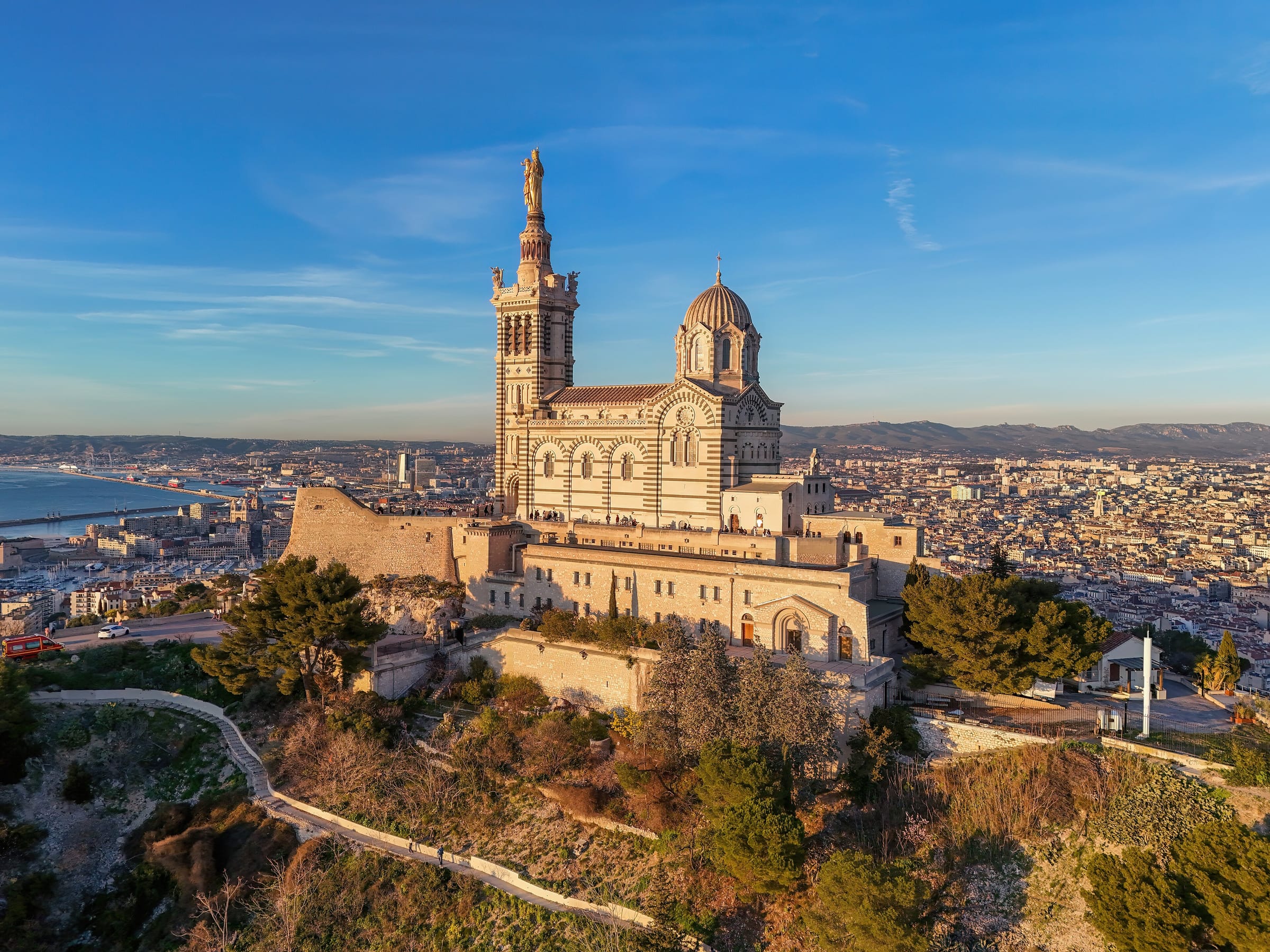
The skyline is anchored by Notre-Dame de la Garde, the hilltop basilica known as the Bonne Mere, which looks over the harbour and the sea. At the harbour mouth, the MuCEM, a museum of Mediterranean civilisations opened in 2013 when Marseille was European Capital of Culture, links to the old fort of Saint-Jean through a footbridge. Le Panier, the oldest quarter, climbs in pastel lanes of street art, ateliers and cafes, and the Palais Longchamp adds a grand nineteenth-century flourish.
Bouillabaisse, the Calanques and Island Views
Food is Marseille's signature: bouillabaisse, the saffron-scented fish stew, is the classic order, alongside panisses, sea urchins, fresh fish at the Vallon des Auffes and the sweet orange-blossom navettes, biscuits from the city's oldest bakery. Cafes serve pastis in the old harbour at the end of the day, and the markets around Noailles offer spices from across the Mediterranean. The city's multicultural kitchens give it one of France's most exciting food scenes, from North African couscous to modern bistros.
Nature is on the doorstep. The Calanques National Park, a dramatic coast of white limestone cliffs and turquoise inlets, begins just beyond the city, with boat trips and walking trails leading to hidden coves. Boats also run to the Chateau d'If, made famous by The Count of Monte Cristo, and to the Frioul islands. Le Corbusier's Cite Radieuse offers architecture lovers an icon of modernism. Nearby, the French Riviera and St Tropez stretch east, while Corsica lies across the sea.
When to Go and How to Reach It
Marseille enjoys more than 300 days of sunshine a year by popular reckoning, and spring and autumn are the most comfortable seasons for walking the city and the Calanques. Summer suits boat trips, beach days at Prado and long evenings by the harbour, while winter remains mild and often bright, ideal for a food-led city break. Sports fans will find the Velodrome atmosphere on match days a highlight in its own right.
The city has an international airport at Marseille Provence, with flights from the UK, and the high-speed TGV links Marseille with Paris in around three hours. Ferries run to Corsica and North Africa. It sits well within a broader Mediterranean itinerary, and works as a gateway to Italy and Provence. A tourist board could use VisitMarseille.co.uk to promote Marseille's sun, food and culture to a new audience, with a city break that feels truly distinctive.
Where to Stay in Marseille, From Harbour to Hilltop
Marseille's districts each suit a different guest. The Vieux-Port is the classic base, with hotels facing the water and the restaurants and markets of the quayside at the door, while Le Panier, the old quarter, offers boutique guesthouses in restored townhouses among street art and ateliers. Couples and culture seekers love both, and the Cours Julien district, to the east, has a lively, creative feel, with galleries, bars and independent shops suited to younger travellers.
Along the Corniche Kennedy, hotels with sea terraces face the Frioul islands, while the Endoume and Vallon des Auffes area offers quiet, local stays beside tiny fishing harbours. The Prado beaches suit families, and the Calanques side of the city, around Callelongue, suits walkers who want a head start on the trails. Business and design travellers will find modern hotels near the Euromediterranee area and the Cite Radieuse offers stays in a Le Corbusier icon. A hotel group could pair the harbour with a calanques-side stay, and Riviera hotels make a natural second week.
Navettes, Panisses and Marseille's Cultural Year
Marseille's food is its great storyteller. Beyond bouillabaisse, try the tiny fried chickpea panisses, soupe de poissons with rouille, anchoiade, the tellines of the coast and the sweet pastries of the Panier. Coffee is taken in harbour cafes, and the historic soap of Marseille, made for centuries from olive oil, is a signature gift, alongside santons, the clay figures of Provencal Christmas, and hand-painted ceramics. The Marche des Capucins and Noailles bring North African and Mediterranean flavours into daily life.
Culture is richly spread across the year. The MuCEM, the Villa Mediterranee and the Cite de la Musique show contemporary and historic art, the Friche la Belle de Mai hosts exhibitions and concerts, and the Fete de la Musique in June fills the streets. Summer brings open-air festivals and boat days, July the Marseille Jazz des Cinq Continents festival, autumn new seasons in the theatres, and Candlemas in February celebrates the city's navettes with a procession. Boards can use VisitMarseille.co.uk to publish the calendar clearly and attractively.
Calanques Trails, Sailing and Provencal Day Trips
Marseille is a rare city with wild nature on its doorstep. Walkers can follow trails into the Calanques from Luminy and Callelongue to the cove of En-Vau, sea kayaking and boat trips explore the cliffs, and divers visit the clear water and wrecks off the coast. Cyclists ride the Corniche and the coast road to the Vieux-Port, and sailors can hire boats for the Frioul islands. Families enjoy the beach at Prado, the Palais Longchamp gardens and the Chateau d'If boat trip.
Day trips extend the stay. Aix-en-Provence, with its fountains and Cezanne's studio, is half an hour away, Cassis offers a picturesque harbour and cliffs, and the Camargue's wetlands and wild horses lie to the west. The perfumed lavender fields of the Luberon are an inland option in summer. Boats link Marseille to Corsica, and the Riviera lies along the coast, with St Tropez a scenic drive away. An airline could pair Marseille with Nice for an open-jaw Provence route.
Planning your stay
Marseille is the oldest city in France and its second largest, with a harbour at its centre. The Vieux-Port, the Panier district, the MuCEM museum and the basilica of Notre-Dame de la Garde are the main landmarks, and the city is known for bouillabaisse and a mix of cultures that makes it different from the polished resorts further east.
To the south lie the Calanques, rocky inlets used for walking, swimming and climbing. Further along the coast, the French Riviera and St Tropez offer a different style of holiday, Port Grimaud adds a lagoon village, and ferries link the city to Corsica.
When to go
Spring and autumn are comfortable for city walking and for hiking in the Calanques, while July and August are hot and busy. Winter is mild by UK standards, with fewer visitors and shorter days, and the city works as a year-round short break.
In summer, access to some natural areas can be restricted when fire risk is high, so check local advice before you plan a hike.
Getting there
Marseille Provence airport is on the northern side of the Étang de Berre, and flights from the UK take around two hours. A shuttle runs to the main station, Saint-Charles, which has high-speed trains to Paris and links along the coast and to Provence.
Within the city, the metro, tram and buses cover the main areas, and ferries cross the Old Port. Ferries to Corsica leave from the port, which makes Marseille a gateway for a combined trip.
Entry requirements
A trip to Marseille falls under France's Schengen rules, so UK visitors can travel without a visa for up to 90 days in any 180-day period as tourists. For Marseille, if you fly into Marseille Provence, your passport must have been issued less than 10 years before that day and must expire at least three months after the day you plan to leave the Schengen area.
On the way into France for Marseille, cash or travellers cheques worth 10,000 euros or more must be declared, including if you land at Marseille Provence.
Before you travel
Entry requirements and official travel guidance are updated regularly, so check the latest position with your government before booking. The sources we used are listed at the foot of this page.
Why Marseille matters to the industry
Marseille is a growing city-break and cruise market with a distinct identity. VisitMarseille.co.uk lets a tourist board, hotel group or airline publish clear guidance on neighbourhoods, transport and the Calanques, and our AI platform carries it to searchers.
See our destination guides and OTA page for how Marseille compares with other Mediterranean city breaks.
Questions travellers ask about Marseille
How long is the flight from the UK to Marseille?
Around two hours from London. The airport has a shuttle to Saint-Charles station.
Do UK citizens need a visa for France?
Not for tourist stays of up to 90 days in any 180-day period in Marseille. For Marseille, your passport must be under 10 years old and valid for three months after you leave the Schengen area.
When is the best time to visit Marseille?
Spring and autumn suit walking and the Calanques, while summer is hot and busy. Check fire-related access limits in summer.
Can you take a ferry from Marseille to Corsica?
Yes, ferries to Corsica leave from the port. Check operators and timetables before you plan a combined trip.
What is Marseille best known for?
Marseille is best known as France's oldest city, founded around 600 BC, and a major Mediterranean port. It is famous for bouillabaisse, the Vieux-Port, Notre-Dame de la Garde, the MuCEM museum and the nearby Calanques National Park.
How do I get to Marseille from the UK?
Marseille Provence airport has flights from several UK airports, and the TGV links the city with Paris in about three hours. Visitors also arrive by ferry from Corsica, and the city is a convenient base for Provence and the Riviera.
Where should I stay in Marseille?
The Vieux-Port is the classic base for first visits, Le Panier suits boutique and culture seekers, the Corniche offers sea views, and Prado suits families who want beaches. The Cite Radieuse is a stay for architecture lovers.
What are the best day trips from Marseille?
Aix-en-Provence for fountains and Cezanne, Cassis for its harbour and cliffs, the Calanques by boat or on foot, and the Camargue for wetlands and wildlife. Each is within easy reach by train, bus or car.
In the Visit Travel Group portfolio: VisitMarseille.co.uk.