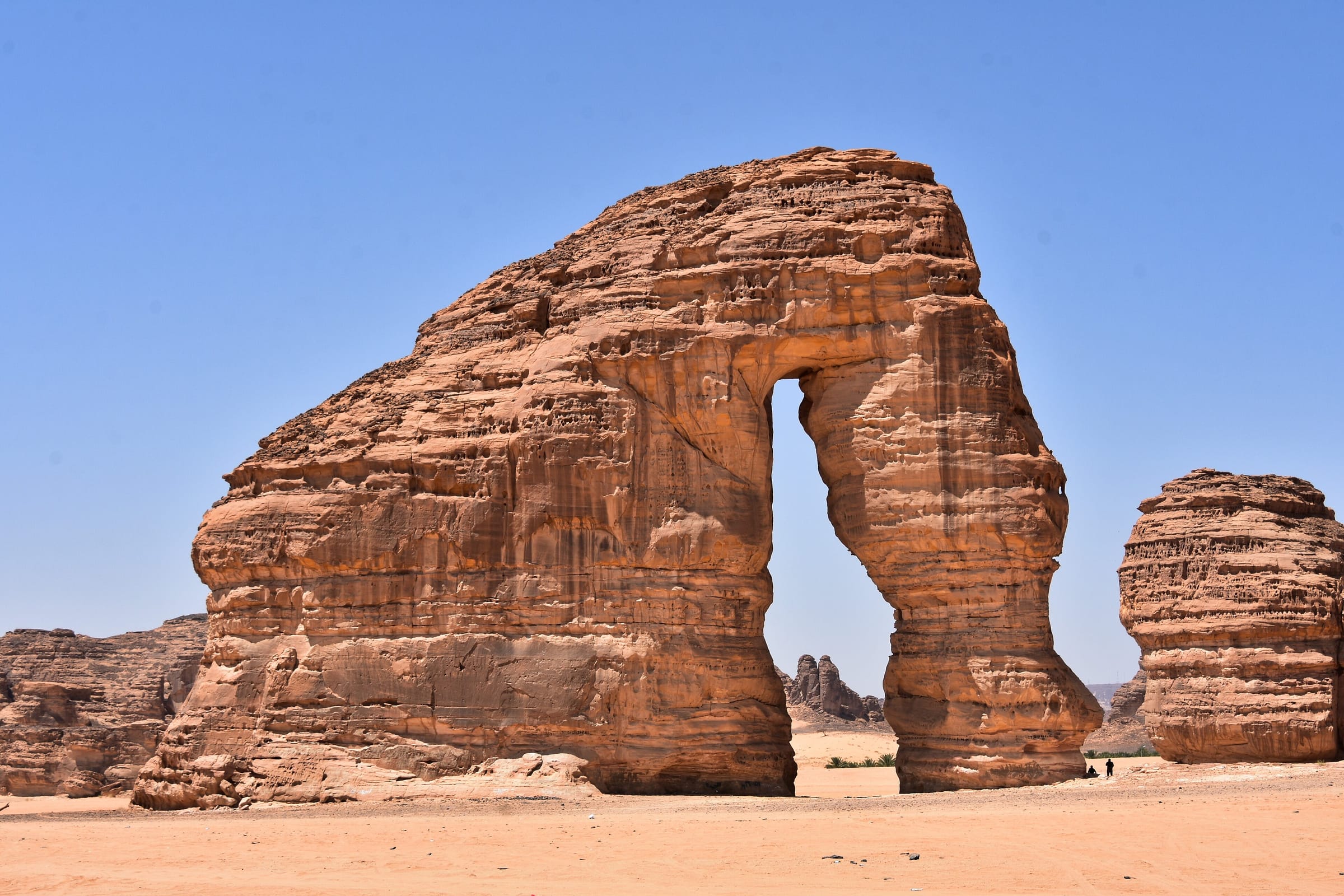
Rock Tombs and Sandstone Cathedrals of the Desert
AlUla is a region in north-west Saudi Arabia, known for its sandstone canyons, ancient oasis and the Nabataean city of Hegra, which in 2008 became the country's first UNESCO World Heritage Site. The valley has been a crossroads for thousands of years, with settlements stretching back through the Dadanite, Lihyanite and Nabataean periods. The dramatic setting, with rock outcrops rising from open desert, makes it one of the most photogenic places on the Arabian Peninsula.
Hegra is the centrepiece: more than one hundred monumental tombs carved into sandstone outcrops, among them Qasr al-Farid, the lone tomb that stands apart in the desert. Nearby, Jabal Ikmah, an open-air library of ancient inscriptions, and Dadan, the capital of an early kingdom, add layers of archaeology. For visitors who know Saudi Arabia as a whole, AlUla is the best place to feel its deep history at close range, in landscapes that reward slow exploring.
Elephant Rock, Old Town and Desert Culture
Beyond the archaeology, AlUla's natural landmarks are strong. Jabal AlFil, known as Elephant Rock, is a freestanding sandstone formation popular at sunset, and the Harrat Viewpoint looks across lava fields and the valley below. In AlUla Old Town, a restored mud-brick settlement of narrow lanes, visitors find cafes, craft studios and a gentle sense of continuity with a living past. Palm groves in the oasis add a cool green contrast to the surrounding rock.
Culture is part of the AlUla offer. The cooler months bring music, arts and desert events, and the Maraya concert hall, a mirrored building set into the desert, has become one of the region's iconic images. A hotel group can find a strong narrative in AlUla's mix of desert retreats, heritage and design, and travellers who like to compare regions will find a coastal counterpart in Jeddah, with its UNESCO-listed old quarter, a short flight to the west.
When to Go and Where to Extend
The cooler season from about October to March is the natural time for AlUla, with comfortable days for exploring tombs and canyons and crisp, clear evenings. Stargazing is a highlight, as the desert sky is exceptionally dark, and dining under the stars has become part of the experience. Local flavours include dates from the oasis, kabsa and fresh bread baked in traditional ovens, and the region's coffee and spice traditions are easy to taste.
AlUla has its own airport, with domestic and some international connections, and the region is also reachable by road from Medina. A name like VisitAlula.co.uk gives airlines and boards a clear way to present the destination, and many guests combine it with the Red Sea coast to the west for a journey from desert to reef. For wider trips, the Gulf neighbours of Qatar and the Dubai emirate can be linked by regional flights.
Desert Resorts and Heritage Stays at AlUla
AlUla's stays are designed to belong to the landscape. Desert resorts tucked against the sandstone cliffs offer villa suites with private terraces and views over rock walls that glow gold at sunset, and are especially well suited to couples and luxury travellers. Tented camps in the open desert give a more adventurous mood, with starlit dinners and sunrise walks. In the oasis, boutique guesthouses and farm-style stays among the palm groves suit families and slow travellers who enjoy shade, birdsong and morning coffee under the trees. The sense of space is the real luxury.
Heritage lovers can choose a stay near the Old Town, where lanes of restored mud-brick houses and craft studios are close at hand, or in the heart of the valley near Dadan and Jabal Ikmah. Groups and celebrations suit larger villa-style retreats, and wellness fans can find spa programmes, yoga and desert meditation. Because distances are short, guests can base themselves in one place for several nights and see most of the region. Saudi Arabia visitors often add a night at a Red Sea beach resort afterwards for a restful end to the journey.
Palm Dates, Coffee and Desert Music Nights
The AlUla table draws on the oasis. Dates, citrus, herbs and vegetables from the palm groves appear in salads and slow-cooked dishes, and farm-to-table restaurants serve lamb, flatbread baked in clay ovens and fresh yoghurt. Saudi coffee with cardamom is poured in the old way, and dessert often brings date pastries and honey. Local artisans work in pottery, weaving and calligraphy, and the Old Town studios let visitors try a craft first-hand. Cooking workshops and picnic dinners among the rocks add a hands-on side to the visit.
Culture shapes the year. The cooler months bring the Winter at Tantora season, with concerts, arts exhibitions, film and food events, and the mirrored Maraya hall hosts performances that glow against the desert dusk. The Desert X art biennial places large installations across the landscape, and spring and autumn suit hiking and cycling festivals. A hotel group could pair these events with stays to create annual signature packages, while Jeddah offers a coastal contrast for travellers continuing across the kingdom.
Balloons, Canyons and Starlit Excursions
AlUla is rich in active experiences. Hot-air balloons drift over the valley at sunrise, giving a wide view of the canyons, tombs and palm groves, and guided hikes follow ridge lines and wadis with views of Elephant Rock and the Harrat. Cyclists and runners enjoy marked routes on quiet roads, and rock climbers and 4x4 drivers find routes of every grade. Horse riding at dawn, camel treks and desert picnics suit families, and stargazing sessions led by astronomers make the dark sky a highlight of every evening.
Day trips and extensions are easy to arrange. Hegra, Dadan and Jabal Ikmah each deserve a half-day, the Hejaz Railway station at Al Ula tells a different story of old travel, and the town of Medina is within reach for those continuing across the kingdom. A journey from desert to coast can finish on the Red Sea reefs, or continue by air to Doha for museums and skyline views. Building a stay around three days of heritage, one of adventure and one of rest makes AlUla feel complete.
Planning your stay
AlUla is an oasis governorate in Medina Province, about 350km north-west of the city of Medina. Hegra, also known as Mada'in Salih, was built by the Nabataeans more than 2,000 years ago and is Saudi Arabia's first UNESCO World Heritage Site. The old walled town and the Jabal Ikmah inscriptions add layers of ancient history, and the Elephant Rock formation is a well known sight.
AlUla pairs with Jeddah for a heritage itinerary and contrasts with the beach resorts of the Red Sea coast. Our Saudi Arabia guide covers the country as a whole.
Entry rules: visa, ETA and e-visa waiver
For AlUla, your passport must have an expiry date at least six months after the date you arrive, and you must have a visa to visit. Tourists can also apply for an e-visa, valid for 365 days and for multiple entries totalling 90 days, online or on arrival at any of Saudi Arabia's international airports, such as AlUla International Airport.
For AlUla travellers, an electronic visa waiver allows a single entry and a stay of up to 180 days, and should be applied for at least 48 hours before your flight.
Before you travel
Entry requirements and official travel guidance are updated regularly, so check the latest position with your government before booking. The sources we used are listed at the foot of this page.
Why AlUla matters to the industry
AlUla is a heritage-led destination with international recognition and a small number of hotels, where visitors need accurate guidance on access and rules. VisitAlula.co.uk lets a tourist board explain the sites, a hotel group present verified properties and an airline explain routes.
See our destination guides and AI platform for the wider model.
Questions travellers ask about AlUla
What is Hegra?
An ancient Nabataean site near AlUla, also known as Mada'in Salih, and Saudi Arabia's first UNESCO World Heritage Site.
When is the best time to visit AlUla?
The cooler months, roughly November to March. The area is hot in summer.
What is AlUla best known for?
AlUla is best known for Hegra, Saudi Arabia's first UNESCO World Heritage Site, inscribed in 2008, with its monumental Nabataean rock tombs, as well as Elephant Rock, Dadan, Jabal Ikmah, the restored old town and the Maraya concert hall.
When is the best time to visit AlUla?
The cooler months from about October to March offer the most comfortable weather for exploring Hegra, canyons and the old town, along with clear night skies and the region's music and arts events. Evenings are crisp and ideal for dining outdoors.
Where should couples stay in AlUla?
Couples enjoy desert resorts set against the sandstone cliffs, with private terraces and sunset views, or tented camps in the open desert for starlit dinners. Boutique guesthouses among the palm groves suit those who prefer shade and a quieter mood.
What is there to do in AlUla beyond the tombs?
Float over the valley in a hot-air balloon, hike to Elephant Rock, cycle quiet routes, explore the Old Town studios, attend a concert at Maraya, or join a stargazing session. Cooking workshops and desert picnics add variety.
In the Visit Travel Group portfolio: VisitAlula.co.uk.